Showing posts with label Justice. Show all posts

Saturday, November 26, 2016

Advent Reflection: Finding A Light of Hope in a World of Darkness

And so it begins: our annual journey toward the Incarnation at Bethlehem, toward the Christ Child who is also the King of Glory. Each Advent is about new beginnings, yet this year, after a brutally antagonistic election and its aftermath, that seems just a little beyond reach.

Personally, I am tired and rather discouraged that the battle for decency, justice, human solidarity and peace seems so much more difficult these days. For now, at least, it looks like many of humankind's baser instincts have been unleashed upon our nation - from all sides of the political divide.

That's why I read that marvelous Collect in the Roman Missal for the First Sunday in Advent differently this year:
Grant your faithful, we pray, almighty God,
the resolve to run forth to meet your Christ
with righteous deeds at his coming,
so that, gathered at his right hand,
they may be worthy to possess the heavenly Kingdom.
Through our Lord Jesus Christ, your Son,
who lives and reigns with you in the unity of the Holy Spirit,
one God, for ever and ever.
Resolve. For me, that is a strong "ask" this year. Negativity cannot be allowed to triumph. Injustice, hatred, prejudice and anger cannot be allowed to triumph. Most of all, fear cannot be allowed to triumph.

I want to run forth to meet Jesus, but my heart is too heavy for that sort of eagerness right now. Lord, grant my heart wings and give the strength to stand upright in your light.

What are the righteous deeds God asks? The core message of the Gospel certainly calls us to love our neighbor. But today, who is our neighbor? For me, my literal neighbors are the Mexican-American family across the hall, the white-like-me single mom and her teenage son next door, the Muslim family down the hall, the East Indian and Eastern European families upstairs, the maintenance guys who only speak Spanish... Yes, these are all my neighbors. Broader than that, however, my neighbors are my "friends" online - people of all races and orientations - on all sides of that very contentious political spectrum.

What righteous deeds will make me worthy to possess the Kingdom? Jesus has defined them in Matthew 25 and the Tradition of the Church has interpreted these as the Works of Corporal Mercy:
To feed the hungry.
To give drink to the thirsty.
To clothe the naked.
To welcome the stranger.
To visit the sick.
To visit the imprisoned.
To bury the dead.
This year, this list seems to present an even bigger challenge. It seems to me that if we profess to follow Christ, we should not only perform these acts on a personal level, but also stand firmly against those who, out of self-interest, desire for financial gain, and prejudice wish to abandon the very people who most need our help.  Should we not speak up when the disabled are mocked, when the elderly are threatened with loss of the "entitlements" for which they have worked their entire lives, when refugees are refused asylum, when women are insulted and assaulted because of their gender, and when all immigrants come under suspicion? Should we not speak up when the rich are rewarded for being rich and the poor are penalized for being poor? And should we not speak up against these forms of injustice just as loudly as we have spoken up.in the name of God for the rights of the unborn?  As the song says, if I don't do that, what good am I?


This is not mere politics. This is a fight for Christian principles against a climate of self-interest and self-righteousness. This is resistance against a culture in which many no longer see justice for all as necessary, because some are more valuable than others. It is a fight to preserve the rights to life, liberty and the pursuit of happiness for all, not just for some.

I want to be able to present Christ with righteous deeds, but today, the responsibility seems particularly heavy. Lord, lift me up and strengthen me to serve and advocate for the "other" - those who are unfortunate, different and rejected.


As I light the first candle on my home Advent wreath tonight, I will most ask for hope. Hope that I might be a light in the darkness. Hope that I will not lose heart. Hope that other people of good will will likewise work while the night is upon us so that when the dawn of the Son of Justice arrives, we will be able to say we fought the good fight in his name.

Come, Lord Jesus!


Sunday, April 26, 2015

The Good Shepherd and the "Different Drummer"

When I was in high school, I liked to think of myself as intellectually superior. It's one of the hazards of being young. It was the 60's - and on TV, I saw that young people were pushing the envelopes of lifestyles and thought. Even though I lived in a small town far from Hippie havens, I wanted to be that too. Also, I was the nerd kid who wore glasses, never dated until Junior year prom. I was the kid reading The Lord of the Rings during freshman study hall and getting weird looks. I was the kid taking 5 subjects instead of 4. I was going to college.  I didn't (and still don't) do chick flicks.

During that time, I thought Jesus was for sentimental people who weren't smart enough to know better.  (I was raised mixed Protestant with a large dose of Unitarian, seasoned with after-dinner discussions of existentialism with my stepfather, a former minister.)

My personal motto was from Henry David Thoreau: "If a man does not keep pace with his companions, perhaps it is because he hears a different drummer. Let him step to the music which he hears, however measured or far away."  I believed I was meant to do that. I was special. I was different. I abhorred mediocrity and my greatest fear was that I would be "ordinary." I did NOT want to be a sheep.

In college, I continued that. I quickly found a relationship with a like-minded young man (who later became my husband) took as many courses as possible each semester, participated in anti-war protests, went to rock concerts and blues bars, spent lots of time in libraries, read voraciously, spent hours in record stores looking for non-mainstream music. We almost never partied. We were serious students. We went to graduate school and the intellectual distance between me and those from my small town widened. I continued to follow the beat of the "different drummer." We were part of the intellectual elite. We were also unchurched.

Fast-forward to 1986. I had, in the meantime had married my young man, who, not incidentally, was an inactive Catholic. Following the usual formula, I promised to raise any children as Catholics. By 1986, my oldest was in preschool and my latent memories of Protestant Sunday School kicked in - I figured it was time to get my boy in.. and I wanted to learn what he would be learning. Next thing you know, I was in the RCIA and joining the Church. The Shepherd had found a lost sheep. (I had a clear vision of a sheep-hook reaching out and grabbing me at one point early on!)

What I found was a Church (and a Jesus) far different from my expectations. I learned to love the parish community - people of all backgrounds and abilities. I learned that it was OK to be a sheep, if I was in the right flock. I learned that my role on earth was to cooperate with God's grace in "building the kingdom."  I learned about the Social Teaching of the Church:  the dignity of EVERY human person, passion for the poor and downtrodden, advocacy for those who have no voice, opposition to injustice... and I learned that the Christian life was not for milquetoasts or intellectual lightweights. (In the personal hardship of the years that have followed, this has only been reinforced.)

I have learned over the years that Jesus Christ is the different drummer in today's culture. That to be Christian is to be truly counter-cultural. In a world where beliefs about life, marriage, and sin are now regularly challenged by the media, the mainstream culture, politicians and those who make laws, we who follow the teaching of Christ and his Church have become the ones who are seen as outside the pale. Others see us as having antiquated beliefs that must be changed. Pretty much they misunderstand those beliefs - and have beliefs from mainstream Christian churches mixed in with those of conservative, intolerant right-wing Evangelicals who have re-written Christian belief as a political agenda. Readers are, no doubt, familiar with all the issues, as hardly a day goes by when some of them are not in the news.

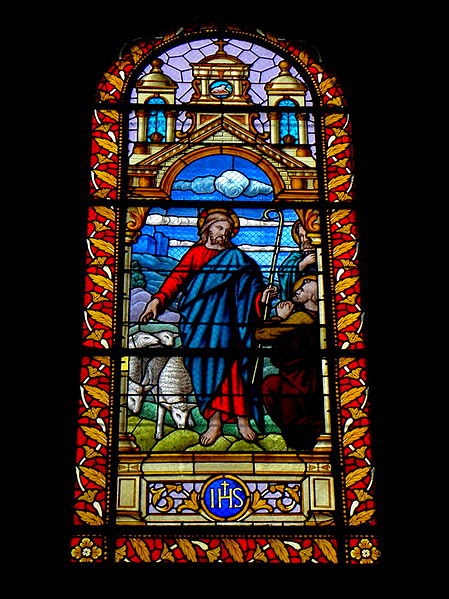
Today, many years out of high school, I can honestly say that I still follow a different drummer. However, he's not some abstract intellectual ideal. He is a living being, who came as a carpenter from Nazareth, who died and rose for our sins, who loves us unconditionally. He is the Good Shepherd who seeks his lost sheep (as he did me) who must weep at much that he sees in today's world. Our vocation, as his disciples, is to weep, too. But also to follow and be faithful, to likewise seek the lost sheep, even in the face of opposition and adversity. We are sheep, but we also are followers who must take up our cross and follow Jesus Christ to Calvary and beyond, who are called to preach, teach and baptize in the name of the Shepherd. Jesus Christ IS my different drummer - and I follow him gladly...


Thursday, April 24, 2014

Discovering Pope Francis' Message of Hope: "The Church of Mercy" (And a Giveaway!)

Hot off the press from Loyola Press, The Church of Mercy: A Vision for the Church by Pope Francis is a beautiful book, full of joy, hope and confidence in the unfailing love of God.  It's a message sorely needed in our times. It's a message, however, that comes with a challenge to give up our own personal agendas and take ownership of the agenda that Christ has given each of us at our baptism.

Consisting of excerpts from his homilies, addresses and official teaching documents, this collection, authorized by the Vatican and compiled by Giuliano Vigini, professor at the Catholic University of Milan, offers the reader comfort, refreshment and challenge, as well as an occasional healthy dose of papal humor.

Pope Francis' pastoral message is that there is hope - for everyone, most especially sinners - in Jesus Christ, and because God is patient, loving and merciful to us, we should be so with one another - especially to the poor and the stranger. We are called to come out of ourselves, abandon our will to that of Christ and simply serve - telling others about Jesus in word and deed - never afraid to show our hope and joy in the process.

We are asked to be an antidote to the evils of the culture by bringing that message out of the walls of churches to the very margins of life, in solidarity with those who have been pushed there - "to the outskirts of existence."  We are called to sensitize the world to the poor and the "uprooted" - refugees - "those who are obliged to flee their own country and exist between rootlessness and integration."

Francis' vision of a "Church of Mercy" is in tune with the social justice teachings of the Church - one that reaches out in love to the poor, the unwanted and those who suffer, in Jesus' name.  Our motivation for that, he says comes from our confident trust that God has already reached out in love to us. When we are able to abandon ourselves to Jesus, we will become a Church that fills the world with his love, one that is not afraid to testify to the message that God loves us all.

But, Francis tells us, before we do any of  this we have to let go of our cultural idols - power, violence, money, and yes, clergy careerism - to be "free from personal projects" and ambition. The Church must "divest herself of the danger of worldliness."  It is that, he says that kills the Church - and the person.  Once we let go, we will be free to choose the good and to become, like Mary, people of "listening, decision and action."


This is quite simply a "must read" book for every Catholic, lay and clergy alike. It proposes a reformed Church much closer to Jesus's intentions and asks us to steer away from worldly trappings - inner and outer - that prevent us from abandoning ourselves to Jesus's call to embrace the love of God and spend ourselves for the sake of others, sharing that love. This is how Francis explains why he himself has chosen not to wear full papal regalia, but to don simpler garb and go out into the world as often as he can, seeking the lost and the broken.  This is the Pope Francis who washed the feet of the disabled on Holy Thursday - Christian and Muslim, men and women - serving as an example, he is the very model of what he calls the Church to become.

Make no mistake. This is not just a "feel-good" book about the warm fuzziness of God's love. It is a real challenge to abandon ourselves to that love.
________

OK -  Here is The BIG Giveaway! 
You can win a FREE copy of this marvelous book from Loyola Press.  Make a comment here on the blog between now and Tuesday, April 29th and I will pick one out of a hat.  Be sure to include your name and an obvious way to find you when you "choose your identity" for the comment box. I will announce the winner on the blog on April 30th. Thanks for reading!

Saturday, March 16, 2013

Pope Francis: What's in a Name? 3 Priorities for the Church

In this touching video, Pope Francis explains to journalists the reasons he chose the name "Francis" for his papacy.  It is clear to me this was a Spirit-led moment in which he responded to what he felt were several of the most-pressing needs in our modern world.  Expressing his longing that the Church become poor and for the poor, he described the charism of Francis:  "the man of peace, the man of the poor, the man who loves and guards creation."

What happened in those few minutes he describes as the final conclave votes were counted was that the Pope's heart was moved by the suggestion of a friend to choose a name that represents exactly what the world needs most right now: peace, solidarity with the poor, and care for the environment.

This is not some retro-hippie flower-child leftist vision, but, in the end, is the agenda of Catholic social teaching. It represents not only the spirituality of Saint Francis, but the very teachings of God himself.

The vision of the reign of God from Old Testament times forward has included peace. Isaiah prophesies: "They will beat their swords into plowshares and their spears into pruning hooks. Nation will not take up sword against nation, nor will they train for war anymore." (Isaiah 2:4)  Jesus reinforced this when he came not as a mighty warrior to defeat the Romans, but instead called for peace, not a sword - and reminded us in the Beatitudes that "the peacemakers" are blessed. Pope Francis mentions that his thought-process included thinking about war (as something very present in the world, no doubt.)  For more on Catholic social teaching about peace and non-violence, see this excellent summary from the Archdiocese of Chicago or the Catechism of the Catholic Church 2302-2317 on "Safeguarding Peace"

 From the Old Testament on, Scripture calls for attention to the poor, with numerous references in the Law as to how they are to be treated (Exodus 22-23, Leviticus and Deuteronomy) and Jesus preferred to associate himself with them rather than with men of wealth. Catholic social teaching has always emphasized standing with the poor. (See the USCCB document on solidarity with the poor  and the Catechism of the Catholic Church 2443-2449 on "Love for the Poor" for more background.) This becomes even more important in a consumer society where some are left out, as our new Pope has already demonstrated by his own actions and frequent mention of the poor.

And, of course, in the beginning, God created the earth and said it was "good", then gave humankind the earth as a gift - with responsibilities attached. The "land" is frequently referred to in scripture as our "inheritance" - a gift we hold in stewardship for future generations. The Catechism of the Catholic Church connects this imperative to the very theology of creation:
Each creature possesses its own particular goodness and perfection. For each one of the works of the "six days" it is said: "And God saw that it was good." By the very nature of creation, material being is endowed with its own stability, truth and excellence, its own order and laws. Each of the various creatures, willed in its own being, reflects in its own way a ray of God's infinite wisdom and goodness. Man must therefore respect the particular goodness of every creature, to avoid any disordered use of things which would be in contempt of the Creator and would bring disastrous consequences for human beings and their environment. (339)
and even more pointedly, this:
The seventh commandment enjoins respect for the integrity of creation. Animals, like plants and inanimate beings, are by nature destined for the common good of past, present, and future humanity. (2415)
Pope Francis will not be the first to preach the message of peace and respect for creation.  Pope John Paul II's 1990 World Day of Peace statement, "Peace with God the Creator, Peace with All of Creation" noted that the ecological crisis is a moral crisis.

These then, are the apparent priorities of the man who has just stepped into the papal office at the call of the Holy Spirit to serve the Church in this time.  He has discerned the world and heard its pain. He dedicates himself with a father's love to help people of faith work together to do what they can to transform that pain into promise. Long may he serve!

Monday, January 16, 2012

Martin Luther King, Jr. - Called to Prophesy

This powerful excerpt from a speech given in 1967 to the Southern Christian Leadership Council shows why Dr. Martin Luther King Jr. was a prophet in his time and a true witness to the message  of the Gospel.

Martin Luther King - Where Do We Go From Here? (Conclusion) from MLK Speeches on Vimeo.

His unfailing sense of the call of Jesus Christ to all people to create a just world, where the hungry are fed and the poor uplifted was extraordinary - and his delivery an authentic call for all to cooperate with God to recreate the world into a living image of the Kingdom is timeless.

Dr. King was a gift to our nation, whose speeches are worth listening to again and again. The blatant racial prejudice he fought against has lessened, to be sure, but the oppression of the poor by the rich and the failure of our nation and world to deliver justice for all still rings true.  One cannot but hear echoes of the current economic situation and political debates in what he said, and wish perhaps, that more had changed.

Sunday, March 13, 2011

What Good Am I, If... A Cry for Charity and Justice

Just found this powerful song from iconic British pop singer Tom Jones, who has reinvented himself as a gospel singer.  His moving rendition of "What Good Am I" particularly struck me as a powerful call to love our neighbor - to step out of our egocentrism and reach out to help, in charity and the change the lives of the unfortunate by working for justice. A great song to meditate on for Lent.


Here are the lyrics:

What good am I - if I'm like all the rest 
If I just turn away - when I see how you're dressed 
If I shut myself off - so I can't hear you cry 
What good am I? 

What good am I - if I know and don't do 
If I see and don't say - if I look straight through you 
If I turn a deaf ear - to the thundering sky 
What good am I? 

What good am I - while you softly weep 
And I hear in my head - what you say in your sleep 
And I freeze in the moment - like the rest who don't try 
What good am I? 
What good am I? 

What good am I then - to others and me 
If I've had every chance - and yet still fail to see 
With my hands tied must I - not wonder within 
Who tied them and why - and where must I have been? 

What good am I if I say foolish things 
And I laugh in the face - of what sorrow brings 
And I just turn my back - while you silently die 
What good am I? 
What good am I? 
What good am I?

Wednesday, January 5, 2011

A Matter of Justice for the Children,,,

Just read an interesting op-ed piece from the New York Times about how the inequality between the rich and the poor affects the emotional psychology of the poor, leading to crime and illness. Couple that with this video from Fr. Allan Deck about immigrant families - and how the kids tend to disrespect the authority of their parents because their parents are disrespected in American society as illegals - which leads to gang activity:


Those of us who catechize and serve pastorally the children of immigrants, and/or those living in lower economic situations need to take note.  How much do these potentially troubled children and youth need our help? More than we know.  Pray for justice for the poor and for immigrants in this, and all nations.

Thursday, June 24, 2010

Catholic in a Protestant Nation: how our concept of time- and work- should be counter-cultural

I have been mulling over a video, The Secret Powers of Time that I found yesterday on the how different concepts of time affect culture and outlook on life. One of the premises is that in "Catholic countries" people are more present-oriented (i.e., they do not plan because they enjoy life and live in the present moment) than those in "Protestant countries" (where people plan ahead because they believe that life does not begin really until after they die, so they work hard to prove they are God's chosen people). While these are generalizations, of course, according to the video there is some truth, if you use the Gross National Product of such nations as an index. 

It reminds me of the oft-quoted line from Anglicized Frenchman and Catholic apologist Hillaire Belloc: "Wherever the Catholic sun doth shine, There’s always laughter and good red wine. At least I’ve always found it so. Benedicamus Domino!"

Now, while  some people would point to the nations of non-planners as "lazy" (check out the remarks northern Italians make about those in the south in the video, or think of the prejudicial comments one sometimes hears about people from Mexico) living in the present moment is also an indication of trust in God's providence to provide. This, actually, is one of the quintessential messages of the Gospel. After all, Jesus said "Consider the lilies of the field, how they grow; they neither toil nor spin, yet I tell you, even Solomon in all his glory was not arrayed like one of these". (Matt. 6:28-29)  This sentiment is at the root of the popular notion of "Let Go, Let God" and the country gospel tune that made the airwaves a number of years back, "One Day at a Time, Sweet Jesus."

So, what does it mean today to be Catholic in the United States, founded as a Protestant nation, rooted in the "Protestant Work Ethic"? This term first was used by Max Weber in his book The Protestant Ethic and the Spirit of Capitalism. It has been in the country's ethos since its founding to point to 2 Thessalonians 3:10 "those who do not work shall not eat" rather than to "consider the lilies of the field".  We are a nation of people who, in general, see hard work as a virtue and, at least up until the current recession, that those who are unemployed must be lazy.  We often hear those who judge people on welfare harshly instead of being sympathetic to the life challenges that foster a welfare culture among the under-educated and poor, mostly black inner city population. 

However, in these harder economic times, it is no longer just the inner-city minorities who are affected. I'm a Boomer. I grew up in the 60's - the last time it was possible to think that "upward mobility" was possible for each new generation - that each would be better off economically then their parents were. We all have heard of young adults who cannot find a job, or who are so under-employed they have returned to live with their parents.  What do such realities say about our own ability to succeed by our hard work?
 
Life on earth should be about more than just the GNP:  Gerard Manley Hopkins, the Jesuit poet, wrote in "God's Grandeur":  
Generations have trod, have trod, have trod;
And all is seared with trade; bleared, smeared with toil;
And wears man's smudge & shares man's smell: the soil
Is bare now, nor can foot feel, being shod.

People of faith, instead of living as though earthly life barely matters, because it's all about "going to heaven", are called to live today, in the moment, not hedonistically and selfishly, but other-focused. We are here to build up the Reign of God (the "Kingdom") here and now - working for justice for the oppressed, the poor and the to make this earth more like what Jesus described in his teachings and actions toward the poor and unfortunate.  He did not indicate that the Kingdom was in the future, but NOW:

Asked by the Pharisees when the kingdom of God would come, he said in reply, "The coming of the kingdom of God cannot be observed, and no one will announce, 'Look, here it is,' or, 'There it is.' For behold, the kingdom of God is among you." (Luke 17:20-21)


This is our work, partnering with God to make God's Reign visible on earth in every sphere, including the economic -  not just being all about the "getting and spending" that English poet William Wordsworth wrote of in "The World is Too Much With Us."  Economic Justice for All, the statement from the US Catholic Bishops, was written to show that "Our faith calls us to measure this economy, not by what it produces but also by how it touches human life and whether it protects or undermines the dignity of the human person."

So, what am I saying here?

First, we should remember not to be judgmental of others whose economic status is lower than our own. While we live in a nation that measures the value of a person by how much they earn, our faith calls us not to see this as who we are. God calls us to see the individual person differently -
 “ For God sees not as man sees, for man looks at the outward appearance, but the Lord looks at the heart.” -1 Samuel 16: 7.  It's not about the house, the bank account, the car or the job a person has. It is about who that person IS.

Second, our work in this world should not be about "getting and spending" but about making the world a better place - not just for ourselves and our famlies, but for everyone, including the poor, the elderly, the unborn - those who are powerless.  We should be counter-cultural within a consumer culture - not running out to buy the latest, newest, thing just because the media and those around us encourage it.

Finally, we are to be all about trusting God, not about trying to do it all ourselves. This is perhaps, the most counter-cultural call of all. In a nation that cut its teeth on Horatio Alger stories about people "lifting themselves up by their own bootstraps" we need to learn that is not always possible, and admit it - for ourselves and for others.