Saturday, July 29, 2017

Nevertheless She Persisted: St. Martha's Profession of Faith

Today is the feast of St. Martha, that woman so often maligned as NOT having "chosen the better part" because she insisted on the tasks of hospitality while Jesus was in her home. She is portrayed in Luke 10:38-42 as a querulous, busy woman, who complained that her sister Mary was not helping with the tasks of serving the 13 guests who had suddenly appeared in their home.

But that is not all we know of Martha in scripture. In John 11:19-27, the first choice for today's Gospel at Mass, she runs to meet Jesus, who has finally come to see Lazarus, having learned he has died.

First, she scolds the Lord with "Lord, if you had been here, my brother would not have died."  However, she continues with "But even now I know that whatever you ask of God, God will give you." She is setting the stage for the possibility that Jesus could raise Lazarus from the dead. Why? Because she believes.

After an exchange during which she assures him she believes that Lazarus will rise on the last day, Jesus says to her:
"I am the resurrection and the life;
whoever believes in me, even if he dies, will live,
and anyone who lives and believes in me will never die.
Do you believe this?"
Never one to hold back, Martha replies with a strong and unequivocal profession of faith: "Yes, Lord. I have come to believe that you are the Christ, the Son of God,  the one who is coming into the world."  Recognize the words of this exchange? They are paraphrased in the final two verses of the popular hymn by Suzanne Toolan, "I am the Bread of Life."

It's no wonder the Church chooses this reading for the Third Scrutiny for those entering the Church as catechumens. This is not just about the raising of Lazarus, but about the power of faith in Jesus Christ.

It's time we rehabilitated our vision of Martha and realized that to see her as the too-busy complaining sister is reductive of her significance. She was a woman unafraid to step out of her culture's preferred subservient role for women to confront a man when she felt it was warranted. Indeed, she is the poster-child for today's "Nevertheless she persisted" meme.

In the medieval world, she was portrayed as the saint of Christian service, but also as a strong force in defense of truth, sometimes shown with holy water and an aspergillium. The French legend still celebrated in Provencal today that she tamed the man-eating dragon Tarasque, which she then led around on a thin chain like a pet, is a vision of a woman of power. Legend even has it that Jesus Christ himself came down to celebrate her funeral Mass.  

Today, on her memorial, remember the woman who stood up to Jesus and boldly told him it was his fault her brother had died, but that she believed Jesus could do anything. What a model of faith - and persistence - for today's doubtful world!


Thursday, June 29, 2017

NOTES FROM NOTRE DAME SYMPOSIUM ON LITURGY & LIFE 2: "Jesus Christ in the Liturgical Year"

"Jesus Christ in the Liturgical Year" - Simone Brosig, PhD
Second set of notes from the June 19-23 symposium at University of Notre Dame. Videos of the talks will  be posted on the McGrath Institute for Church Life YouTube Channel.

Simone Brosig is Director of Liturgy, Roman Catholic Diocese of Calgary, Calgary, Alberta, Canada

Photo by Tim O'Malley
Name your favorite moment in liturgical year.

School liturgy example from real life - it's all about them. Diocesan school leadership Masses on August 31 and Nov. 1st built around "theme of the year" - same music, same readings, all picked to support the theme,  unaware that the liturgical year is primary. They started with their agenda - it was not about encountering Christ. Liturgical year should be their starting point.

See Sacramentum Consilium 10, General Norms on the Liturgical Year p. 2

Liturgical year first started with Easter, then gradually, over time, it became a season... By 4th century Christmas was added. These 2 cycles make up the lit year - everything else is geared around them.

Proper of Time takes precedence. (SC 108) Easter Cycle, Christmas Cycle, Ordinary time.  Sanctoral time (saints' days) is secondary.

Starting with Advent at the beginning was not a practice until the 10th or 11th century.

Liturgical year not conceived as a whole. It grew out of the Paschal Mystery. Every encounter of the liturgical year provides opportunity to encounter a particular aspect of Christ's grace.

We should ask where did we meet Jesus this year in the celebration of ______?
This helps us develop our spirituality and attitudes.

See SC 12 - we are touched by the mysteries of redemption.

Liturgical year shapes us and our discipleship. An instrument of evangelization and invitation to encounter with Jesus Christ.

People who aren't connected to the liturgical year aren't connected to themselves.  (Her story - stressful family issues around Christmas had distanced her from Advent/Christmas) Spiritual director told her to participate in the whole Christmas cycle. That practice gradually changed how she sees Advent and Christmas.

To connect to the liturgical year, we have to connect to ourselves.  It can shed new light on our inner life.

Advent to Dec. 16 - Eschatological emphasis.  Dec 17-24 - oriented toward the Lord's birth.

Cycle A
Psalm 85 - first Sunday - comfort
Psalm  second Sunday - promise
Communion antiphon 3rd Sunday - courage

Overall Advent is an invitation to get in touch with our fears and vulnerabilities. Not penitential in the same way as Lent. Devout and expectant delight. Yet, we may discover our own exile.

When the Baby comes, we put aside our agendas. That's what the liturgical year calls us to. Paradox of triumph through weakness.

Liturgical year is not a passion play. We are not expected to change our moods to correspond with it.   Even in the 50 days, we may experience grief.  The good news of the Resurrection comes with an edge -  we remember his suffering,  Palm Sunday reminds of us the willingness of Jesus to go to Jerusalem even though it meant death.  The Empty Tomb is not a source of joy, but of grief until the Resurrection is discovered.

Evangelization through the liturgical year needs to be invitational, not directive.  Ritual greetings of the Eastern church are faith statements:
Christ is risen. He is risen indeed.
Jesus is born. Let us glorify him. (invitation)

Liturgy and Life
We need to discover moments in the Liturgical Year that we look forward to. We need to allow the liturgy to work on people. It's not directive, it's invitational.

- The Word is a starting point.  Proclaimed well, liturgical preaching...
- Music should shape the celebration
- Bring the liturgy to the life of the parish - sing seasonal music at meetings and gatherings
- Good liturgical art. We can create it to sanctify other spaces - and bring it home  Candlemas candles and Advent wreaths bring the liturgical year into the home.

Liturgical practices can become part of identity. Ash Wednesday, for example. Young adults mark time, take it into their bodies and identify.

Monday, June 26, 2017

NOTES FROM NOTRE DAME SYMPOSIUM ON LITURGY & LIFE 1: "On Jesus Christ and the Liturgy"

First set of notes from the June 19-23 symposium at University of Notre Dame. Videos of the talks will  be posted on the McGrath Institute for Church Life YouTube Channel.

"On Jesus Christ and the Liturgy" Fr. Khaled Anatolios, PhD
Fr. Kahled is a priest in the Melkite Greek Catholic Church, and Professor of Biblical Studies/Christianity and Judaism in Antiquity at University of Notre Dame

"There is one thing I ask of the Lord: to dwell in the house of the Lord forever." Psalm 27
Christ is the point of human encounter with God. Two natures together in one person.

Church Fathers referred to Psalm 85:10  "Truth has sprung up from the earth..." - with the incarnation God is no longer just in heaven (Augustine)

Liturgy is the event in which the encounter of God and humanity become available and we can participate in it. It is a Christological encounter. A multitude keeping festival = the Church. In the liturgy we become one body, one spirit in Christ. We encounter each other in Christ.

Liturgy as Exodus.  Every liturgy is Passover. We pass over to freedom in the spirit from death in sin. It begins as soon as we begin our preparations for going to Mass.  But it doesn't happen through our efforts.  Christ doesn't wait for us. He goes out to accompany us.  It begins with the family preparation. But also within spiritual preparation. What do we need to be liberated from?

Liturgy as Kingdom.  In Eastern Church, we begin "Blessed is the kingdom in the name of the Father, Son and Holy Spirit.  Jesus came to say that "the kingdom is among you" (literal translation of the Greek)

PENITENTIAL RITE AND DOXOLOGY (The "Gloria")
If the liturgy is a Passover, we begin by leaving something behind. In the Penitential Rite we declare our liberation from sin in Christ and announce the kingdom. (Repent!) And leave behind what is not the kingdom.

Christ never receives our confession, because he has already given his grace to us and has repented on our behalf. He leaves behind all that

LITURGY OF THE WORD
Epistle to the Hebrews opening.  Continuity - God the Father gathers up all the ways he has been speaking and places it in Christ. Scripture is communication of the incarnation. The opening of the Epistle clears the way for the proclamation of Christ. When we hear Jesus proclaimed in the Gospel, we encounter him.

LITURGY OF THE EUCHARIST
Liturgy as sacrifice - we need to recover the meaning.  Last Supper:  "This is my Body" = This is my Life. "This is my Blood" = This is my death. Christ can do this because he is in command of his life and death.  (John 10:18)  This communicates the sacrifice.

See Hebrews 10:1-14
Jesus's self offering is his whole will to the Father.  He offers all of us in himself. Perfects for all time those who are sanctified.  It is a love covenant with God - "here I am to do your will."

What happens to sin in the middle of that offering?  How does Christ take away the sin of the world? (As Lamb of God.)  In real sacrifice, you have to enter into - to empathize with the other.  Christ enters into our humanity with all its messiness and becomes part of it... His pain was greater than any human pain because he suffered all the woundedness of the world because he empathized and took on all our suffering. He did this while in the Trinity, so it becomes part of the holiness of the Trinity.

Eucharist needs to be spiritually digested because it's spiritual food - it is digested spiritually by contemplation and through reflection on Scripture.

EPICLESIS
The Holy Spirit is the "extrovert" member of the Trinity.  It comes down and transforms the bread and wine and then it transforms us.  Every Eucharist is a Pentecost.

GO IN PEACE
Jesus never says "Peace be with you" except after the Resurrection.  The peace of Jesus is a definitive peace.  The peace of a fullness of communion, of encounter between God and humanity. Humanity is fully integrated into the life of God - and we are sent to bring this peace to the world.

Q&A
Pope Benedict in Sacramentum Caritatis... we bring the pain and suffering of the world and offering them with the gifts.

We lift up our hearts with Gods help.  We get new hearts from God at the liturgy.

Monday, May 8, 2017

BOOK REVIEW - Jesus: The Story You Thought You Knew

How's your walk with Jesus these days? That's really the question that Deacon Keith Strohm wants to know.

In his new book, Jesus:The Story You Thought You Knew  (Our Sunday Visitor) Strohm retells the story of salvation from Creation to you - explaining it in an easy, accessible way. It's a bit like being on the road to Emmaus and having Jesus break open the scriptures that explain who he is, why he came and why he died and rose again.This isn't a long book, but it's one to spend time with.

Strohm preaches it. This is not so much a narrative, but a series of engaging, evangelizing tracts. The book reads like a collection of extended homilies with a purpose. Each chapter is a powerful encounter with the truth of the kerygma, from the story of Creation to the Cross and beyond. All this is presented with the fervency of witness, by a man who has walked the journey himself.

Strohm, former director of the Office for the New Evangelization of the Archdiocese of Chicago and a protegee of Sherry Weddell (Forming Intentional Disciples) and the Siena Institute, has, with this endeavor, put his own voice out there as he strikes out on a new part of his own journey, an independent ministry, M3 Ministries, which is in development.

In this short but powerful book, each "Act" of the story, as he refers to them in "How to Use This Book," is an invitation to a journey -  one that begins with Strohm laying out the scriptural background and its meaning. He then adds theological implications and includes stories and examples from his own real, imperfect human life, ending with an invitation to reflection on pertinent scripture passages. The chapters conclude with life implication questions to consider individually or to use in group discussion, which means it could be used for evangelizing older teens, adults, or as part of RCIA pre-catechumenate sessions.

Once the reader has encountered the meaning of the Great Story, he/she is invited into relationship with Jesus - to repentance and participation in the sacraments, to openness to the Holy Spirit and finally to discipleship and action.

This is a book to savor and study. If the reader takes the time to go to the scripture passages, to read and pray over them, there is ample opportunity for conversion. There is real potential for becoming a disciple who understands who Jesus is, why he came, and what he means for us today.


Sunday, April 30, 2017

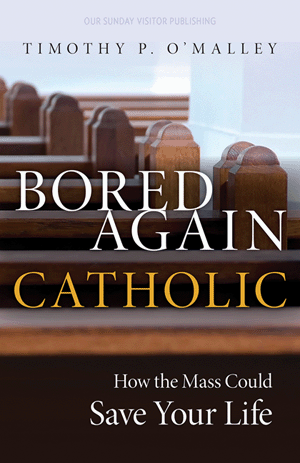
BOOK REVIEW - Bored Again Catholic: Journey to the Center of the Mass

Timothy O'Malley and I come from two very different generations. I'm a baby boomer grandma with a pastoral studies degree and 30 years practical experience in liturgy and catechesis, working in diocesan ministry. He's a millennial with a young family, a doctorate, and an academic directorship in addition to a teaching career at Notre Dame. However, he can certainly speak wisdom to someone my age... actually to people of any age.  

When I started reading his latest book, Bored Again Catholic: How the Mass Could Save Your Life, a little voice in my head kept telling me that Tim lives in a different reality than I do. Although he has much to say to young adults, especially to students in college (and campus ministers), who are his intended main audience, he acknowledges in his introduction that this book might  offer the rest of us, who struggle to convince young people to go to Mass "something that will revive your weary souls." OK, I thought. We'll see. 

For the first few chapters, I read through my teaching lens, thinking about the catechetical potential of the book and what I could recommend in it for others who minister in parish life with teens and young adults. Since I work primarily with directors of children's religious education, I was mentally including young adult parents of children in faith formation programs. I pretty much distanced myself from the book and honestly underestimated its effect on me personally. 

I will admit that from the first I was aware that going back and really exploring the questions and suggested practices at the end of each chapter could take me much deeper and that this book had great potential that would not yield itself up to a first quick reading, but I shelved those thoughts for later exploration.

Today, at the first Mass I participated in since reading the book, God had other ideas about how to upset my carefully cultivated distance from this book. It started at the "Gloria." Yes, I was the cantor - and of course it's Easter Time and I usually can lead this with joy, but today, the comparison from Chapter 6 of the "Gloria" to a "fight song" such as we sing for our favorite team at an athletic event hit me. I felt a burst of great energy and delight as I led the people in the singing. In fact, I felt renewed and refreshed.  

At the Gospel, which was today about the two disciples on the road to Emmaus, I immediately recalled the reference to this same Gospel reading in Chapter 12 "The Homily", where Jesus' interchange with the two disciples is referred to as "the Gospel of Luke's most famous homily."  The goal of the homily, O'Malley says, "is not to report on the most recent findings in historical-critical scholarship. It is instead to show us the coherence of God's narrative of love."  That's a theme in this book: the love of God shown through the sacrifice of Jesus is at the heart of the Mass. I felt it as the Mass continued, and I as able to offer myself unreservedly, to join in the sacrifice more wholeheartedly than I had been of late. In short, this book affected me more than I initially thought it would. 

Bored Again Catholic is much more than an explanation of why one should not succumb to boredom at Mass. Instead, it is an extended meditation on the connection between liturgy and life, a virtual journey to the center of the Mass. It is at one and the same time revelation, information and an engaging tale of how one man has found ways to enter into "full, conscious and active participation" in the Mass and how to truly offer himself in sacrificial love (the theme of his previous book, Liturgy and the New Evangelization: Practicing the Art of Self-Giving Love. Tim may not be everyone, but he offers himself, exposed in his humanity, as a model, showing us how his inner journey with elements of the Mass can serve as an example. 

A significant treasure in this book is the author's personal witness to his own struggles and how he has let the graces of word and sacrament shape his interior life. He shows us how engaging faithfully in the repetition of listening, praying, responding, and offering one's life as part of the sacrifice of the Mass can bear fruit. Tim is not shy about sharing his and his wife's battle with infertility - or his joy in adoption, which, as he tells it, became possible because of the work he engaged in during the liturgy. Again, he models a faithful response to Christ's sacrifice of love and our work in re-echoing that in our own lives as we continue to grow spiritually through faithful openness to God's work in us.

And no, it's not all about struggle. Tim shares with us charming moments of family joy, silliness and triumph. The antics of his toddler son at home and at Mass are a welcome dose of little things from real life that echo the imperfections of human life and the mission of love on which the Mass sends us. 

His explanations of the meaning and structure of the Eucharistic Prayers and the Lord's Prayer are joyful catechesis at its best. It is clear he loves these words and wants others to do the same. Indeed, it is clear throughout the book that what O'Malley really offers is an invitation to a life in which the Mass has a primary role. This is the invitation we want young adults to receive and take to heart: that the Mass has the power to uplift and change them, to send them forth to be people of sacrificial love.  

There is plenty of additional treasure to be discovered in the questions and suggested practices at the ends of each chapter.  I would urge you to take  time with them, I plan to. In fact, this is a book to be savored and studied, marked up and revisited - by adults of any age. 

Friday, April 14, 2017

Good Friday: We Come to the Cross as We Are

Our Good Friday Passion Service ended about an hour ago. It was marked by solemn, beautiful silence and reverence. Not exactly a full house, but our English celebrations often aren't in my mostly Spanish-speaking parish. But the community gathered there to hear the Passion and venerate the Cross was just enough.  Everyone who was meant to be there was.


During the Veneration of the Cross, I watched as Father, one of our deacons-in-training and the two Eucharistic Ministers carefully raised the cross to a position where most of us could reach it, nearly upright. I came forward, gave the cross a bit of an embrace before I kissed it. Then I wound my way back to my seat.

As I looked up, I saw her. One of our parishioners has severe disabilities that keep her confined to a motorized wheelchair. She inched her way forward in the line, pulled her chair up next to the cross, but was still unable to reach it. As she started to struggle to her feet, our pastor and one of the ministers instantly, as if synchronized, reached out and supported her by the arms, pulling her up so she could kiss the wood of the cross. As she sat back down and shifted her chair to move away, I found myself in tears.

We each come as we are to the cross. When we do it as a community, when we help one another, it speaks of the wondrous love of God who came among us to suffer and die on that Cross. Tonight I have another Triduum snapshot to add to my memory scrapbook.


Thursday, April 13, 2017

Paschal Mystery: How the Easter Triuduum Helps Us Walk With Grief

It's Holy Thursday morning, and once again, we stand at the brink of the celebration of the Easter mysteries. In fact, what we will experience from tonight through Easter day is the heart of what we pray at Mass every time: "The Mystery of Faith" - the very death and resurrection of Jesus Christ, which we call the Paschal Mystery.

Paschal Mystery symbol in Freising Cathedral, Bavaria
Meanwhile, real people are suffering their own versions of paschal mystery. In a conversation this morning on social media, a friend whose wife died of cancer a while back reminded me that he had learned his wife was losing her battle with the disease from a phone call while on his way to the celebration of Good Friday. I am conscious that another friend learned a few days ago that his wife's cancer has metastasized and is now inoperable. 

Almost eight years ago, I suffered a major loss when the man I had intended to marry died suddenly. Most of us, if we have lived long enough, are, like Jesus, men/women of sorrow, well-acquainted with grief. Grief and suffering are very real and inevitably a part of the human life in which Jesus came to earth to share with us.

This is where deeply surrendering to the experience of the Easter Triduum and walking through the Paschal Mystery can be restorative. If we are open and ready to accept the message that the love of God for us is so strong that Jesus, by his dying and rising changed human death forever, we can receive healing of those deep wounds that grief impresses on the heart.

As usual, what we pray in the liturgy throughout the church year, especially in the celebration of funerals, is what we believe.
In him the hope of blessed resurrection has dawned,
that those saddened by the certainty of dying,
might be consoled by the promise of immortality to come.
Indeed for your faithful, Lord,
life is changed not ended,
and, when this earthly dwelling turns to dust,
an eternal dwelling is made ready for them in heaven.
(Preface for Christian Death I)
For as one alone he accepted death,
so that we might all escape from dying;
as one man he chose to die,
so that in your sight we all might live for ever.
(Preface for Christian Death II)
Even more impressively, in Preface V, we have this:
For even though by our own fault we perish,
yet by your compassion and your grace,
when seized by death according to our sins,
we are redeemed through Christ's great victory,
and with him called back into life.
We don't even have to go to a funeral or memorial Mass to hear this reassurance of eternal life. It is, of course, embedded in the prayers of every Mass. However, at the Masses of Easter we will hear it reemphasized:
For he is the true Lamb
who has taken away the sins of the world;
by dying he has destroyed our death,
and by rising, restored our life. (Preface I of Easter)
Through him the children of light rise to eternal life
and the halls of the heavenly Kingdom
are thrown open to the faithful;
for his Death is our ransom from death,
and in his rising the life of all has risen.  (Preface II of Easter)
What is the message? HOPE. In the midst of the suffering of this world, we have the promise that this earthly life is not all there is. Hearing this message over and over again, for all the years necessary until we each are ready to let go of tears for our beloved dead and can instead manage to see their faces as "the children of light" and feel their presence around the altar at every Mass - this is the power of the Eucharist to heal the effects of grief. 

Each person heals from a great loss at his/her own rate. I cannot pretend that grief ever really goes away. Anyone who has walked its dark corridors will tell you it's a myth that time heals it all. Grief always lurks behind that closed door of the heart, waiting to ambush us when we are "triggered" into remembering, as Edna St. Vincent Millay wrote so perceptively:
Time does not bring relief; you all have lied
Who told me time would ease me of my pain!
I miss him in the weeping of the rain;
I want him at the shrinking of the tide;
The old snows melt from every mountain-side,
And last year’s leaves are smoke in every lane;
But last year’s bitter loving must remain
Heaped on my heart, and my old thoughts abide.
There are a hundred places where I fear
To go,—so with his memory they brim.
And entering with relief some quiet place
Where never fell his foot or shone his face
I say, “There is no memory of him here!”
And so stand stricken, so remembering him.
For me, preparing to enter the great mystery of the Three Days is a reflective time for emptying myself and reaffirming that the reason we can find joy in celebrating these intense days of walking with Jesus Christ through suffering and death is that he has indeed risen from the dead and offered our deceased loved ones - and us - the gateway to eternal life with God. 

When the words of the Easter Proclamation (Exsultet) ring out in the darkness at the beginning of the Easter Vigil, I will be there trembling with barely suppressed joy because I truly believe that  "This is the night, when Christ broke the prison-bars of death and rose victorious from the underworld."  Because of what Jesus did, death can no longer conquer us. It is not the end. Our loved ones are alive in him.

As Christians, we must each, whenever we are ready, climb out of our personal despair from grief at the death of those we love. We can, through faith, join them around God's altar when the earthly liturgy meets the heavenly liturgy at every celebration of the Mass, knowing that someday, we too will be rejoicing around God's throne, united with them in him, for all eternity. 

Today, I pray for all who grieve and for all those facing the certainty of the death of those they love, that they may receive the gift of faith that I have been granted, and through the power of the liturgies of the Three Days, come to know the truth that for their beloved ones, that "life is changed, not ended."