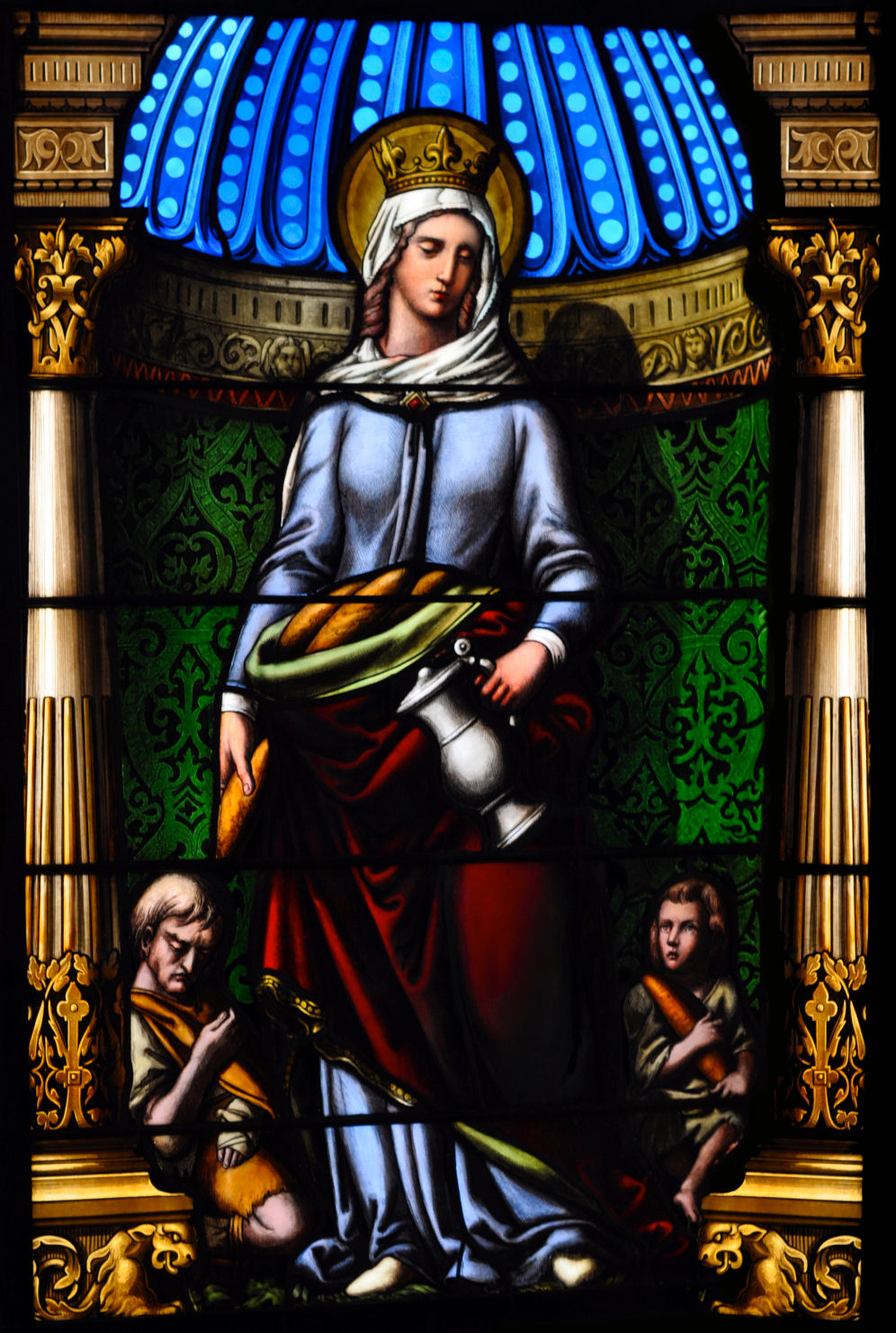
This coming weekend, we will hear the familiar story of Mary and Martha, where Martha complains that her sister is too busy listening to Jesus and not helping with the meal preparation. Jesus chides her, accusing her of being worried about many things and assures her that her sister has taken the "better part" sitting at his feet. We all know that story. Martha is usually depicted as a nag, and Mary as the more spiritual member of the family. Sometimes the two have been used to represent the active and the contemplative life, with the value often falling on the latter.
Yet later tradition honors Martha. She is patroness of those who serve - cooks, housekeepers, waiters and waitresses - and sometimes, Christian service. There is a place for those who serve and wait upon others, a place for those who prepare the table. They, too, are necessary, or meals would never get prepared or served. Someone has to feed the hungry. Jesus says man does not live by bread alone, not man does not live by bread at all.
Oddly, Martha is sometimes depicted in iconography as leading a tame dragon on a leash. The story originated in France that Martha, Mary Magdalene and Lazarus arrived there a few years after Jesus death and settled in Avignon. When the people of Tarascon, in Provencal, were being terrorized by a dragon, they called upon St. Martha, who went to the dragon, tamed it and brought it back on a leash. The people, of course, immediately converted to Christianity.
Today, that image of Marth the dragon has been perverted in some cultures to become Martha the Dominator, a kind of powerful "dark side" icon popular in voodoo and some areas of Latin America, often depicted as a wild-eyed woman with streaming hair handling snakes.
Why do these traditions see Martha as a woman of great power? Perhaps the clues lie in her forthrightness in Scripture. Martha does not fool around. She says exactly what she is thinking. She takes charge. She rushes to meet Jesus when he comes to see them after the death of Lazarus, while her sister stays home and weeps. She is unafraid to blame Jesus - "Lord, if you had been here, my brother would not have died." But then, she names Jesus outright as Messiah, the only other to do that besides Peter:
"Yes, Lord,” she replied. “I have come to believe that you are the Messiah, the Son of God; He who is to come into the World.” (John 11:27)
It is Martha's active faith - as strong as Mary's spiritual bond with Jesus, that makes her worth emulating. Her belief in him is powerful enough to know that whatever he commands will happen - that, if he wills it, the dead will be raised. Belief is power. This has to be the basis for the legends that grew around her later.
So this weekend, when you hear the story of Jesus scolding Martha for asking her sister to help with dinner, remember that there is more to Martha than this story. St. John depicts her here as the antithesis of the contemplation of Christ. Yet later, he will depict her as one of the first and most faithful witnesses to his identity, unafraid to ask him for what she wants. For those of us who live in the world. Martha is worth emulating. Our faith, like hers, should be unshakable, based in common sense and service. Like Martha, we need to believe that Jesus can bring new life into even the most dire of circumstances.
This is the first major document to appear complete with PDF download and social networking buttons, signaling a willingness on the part of the Vatican to make documents more accessible. The much-maligned parchment is now a background, while the text appears on a lighter ivory. An improved, clearer font also enhances readability.
This popup when you go to the main Vatican webpage invites you to "leaf through" the document (in booklet format) or download the PDF.
Good for them! The change is very welcome and will make the teachings of the Magisterium more accessible and easier to share.
And, bonus!! There is also a separate companion site just posted by Jared Dees (Ave Maria Press) for the encyclical http://lumenfidei.com/ that includes study guide and outline.
This past weekend's readings, where several people receive calls from God and are tempted to take care of worldly concerns first - barbecuing the oxen, burying a father, etc. reminded me of a time in my life when I had that experience... and heard those readings in a very real and life-changing way. It's a tale of struggle, but one I am convinced proves that God has something in mind for each of us and is never far away. Several people have mentioned I should write about this, so here it is. It is my witness to the power of God's call.
I had received my Masters in Pastoral Studies (with emphasis in Liturgy) from Loyola Institute of Ministry Extension (LIMEX) in 1994, but had been unable to find full time work in ministry. By 1997, I was still working as secretary for a diocesan vicar for clergy (priest personnel) and part-time as liturgy coordinator in my parish, while moonlighting as a reviewer of classical music concerts for the local newspaper. I could not help feeling this was not what I wanted in the long term. A change in supervisors a couple years before had made me restless as my relationship with the new one was slightly rocky - unlike his predecessor, he did not treat me like a partner in ministry.
In the fall of 1997, I had made my Cursillo weekend, despite some severe health issues prior to major surgery - a long story, really - but during the weekend I had had an epiphany. For months before that, a "voice" in my head kept saying "Bloom where you're planted." I wasn't really blooming, just really getting by. After making a pretty routine confession at the Cursillo, I heard that voice again as I returned to my seat in the chapel. I finally rebelled - and retorted inwardly "I CAN'T bloom where I'm planted - I HATE where I'm planted!" Back at me, I heard, quite plainly "Then plant yourself where you can bloom!" That completely shocked me. I had never thought of leaving the city where I had lived for 19 years, raised my children and had my parish roots. I would never have considered it on my own.
That experience set off a job search which lasted for a number of months, with a number of false starts. However, when things did fall into place there was no mistaking that the choice to leave everything familiar and to follow that inner voice of the Spirit was the right one. Here's why:
Liturgically, Lent 1998 was the worst thing ever in my parish - everyone was at each other's throats and an "interesting" decision by the environment committee had unleashed a small firestorm. As the embattled coordinator, I could not help but feel that the "tail of the snake", as St. Ignatius refers to it, was slithering around every corner. I felt like it was time to leave.
Several job interviews were pleasant, but not successful. Nothing surfaced.
I had the surgery in January - the recovery was 6 weeks away from work, during which I had time to think, discern and pray. I kept the regimen of walking around the neighborhood each day. That's when it happened.
One day, after an interview during which I found out that a parish seeking a liturgy coordinator was actually looking for an organist, even though that had not been advertised, I went for that daily walk. I was sad that this had not worked out, and in conversation with God about what he could possibly want from me. As I walked, I encountered a piece of a broken dish in the alley. Since I am a cantor and the psalms are all stuck in my head somewhere, the first thought was "I am forgotten like a dish that is broken." (Psalm 31:12) Picking up the fragment, I took it home, wrote the psalm verse on the back of it with a marker and put it into a box of prayer objects. God was obviously still in the process, I thought. Unmistakable sign.
Later that day, I talked to a friend in ministry - who told me that the parish I had just interviewed with had been replacing their director of religious education, had someone, but that person had just reneged on the signed contract. I called the diocesan RE office and asked the director what were the minimum requirements for becoming a DRE: a master's degree and three years as a catechist was the answer. I had that! I immediately wrote the pastor a thank you note for the interview. I also mentioned that I had heard they were now looking for a DRE, and that I had the minimum requirements for that position. The next day, after he opened his mail, he called me and said "We need to talk."
What resulted was the creation of a dual position in religious education and liturgy. What happened next is that I had to get ready to leave all that was familiar - to go to a town where I knew exactly no one to do the work to which the Lord was calling me. It was frankly scary.
Over the weeks prior to my departure I heard a series of readings at Sunday Mass - John the Baptist saying that if the tree does not bear fruit it needs the ax - and a version of the story we heard this weekend - with the line “No one who sets a hand to the plow and looks to what was left behind is fit for the kingdom of God.” I know God was speaking directly to me. I left. I did not look back. My life was changed... forever.
That was 15 years ago. The journey later led me to diocesan ministry and life in a mostly-Hispanic parish. I have never regretted a thing because I have always known this was all part of the call. No turning back.
In today's Gospel we heard about resurrection from the dead:
Jesus journeyed to a city called Nain,
and his disciples and a large crowd accompanied him.
As he drew near to the gate of the city,
a man who had died was being carried out,
the only son of his mother, and she was a widow.
A large crowd from the city was with her.
When the Lord saw her,
he was moved with pity for her and said to her,
“Do not weep.”
He stepped forward and touched the coffin;
at this the bearers halted,
and he said, “Young man, I tell you, arise!”
The dead man sat up and began to speak,
and Jesus gave him to his mother.
Fear seized them all, and they glorified God, exclaiming,
“A great prophet has arisen in our midst, ”
and “God has visited his people.”
This report about him spread through the whole of Judea
and in all the surrounding region. (Luke 7:11-17)
Of course, Jesus raised man who had died. What is not as clear is that he metaphorically raised his mother from a kind of death as well.
In a time and culture when a woman only had status if she had a husband or a son, to be a widow and to have one's only son die was a kind of death. Had Jesus not reversed this, her future would have been bleak. Most likely, she would have been totally without resources. Her old life would have been gone, her new one a kind of living hell. Her future was hopeless, so when Jesus had pity on her, it was not just because of her grief, but because he knew what would become of her. The resurrection of her son meant she could live again and once more have an identity and dignity in her community. She, too, was "resurrected".
Do we have the courage not to lose hope in our times of dire loss and transition, knowing that Jesus can reverse the most negative of situations, as he did with the widow - as he did with his own death on the cross? Do we believe in Paschal Mystery - in the undying hope that Christ brought us? Pray for the virtue of Christian hope. It does not come easy in a world sometimes so full of loss and pain.
Now I am truly convinced we need better and more sacramental catechesis for Catholics of all ages.
Over on the Nineteen Sixty-Four CARA blog, Mark M. Gray presents evidence of the failure of religious education - literally half of adult Catholics in the American Catholics in Transition survey are unaware that that Church teaches Jesus is really present in the Eucharist. Just look at the graphic:
Gray makes the point that actual "Knowlegeable Doubters" are very few, but that half of adults don't even know the Church teaches about Real Presence.... yet this is quite simply the most important of all Church teachings about the Eucharist! He points out what the statistics mean: "Now we know that lack of belief in the Real Presence is more a problem of religious education than of doubt."
What's the problem? Why has catechesis failed with literally half our people? What are we doing wrong? Well, let's think about it.
When do we normally catechize people about the Real Presence? When they are seven years old, preparing for First Eucharist. Yet, at that age, are people even ready for the concept that Jesus Christ, body and blood, is really fully present in that bread and wine? We can tell them, but it may or may not make sense. Real Presence is not only an advanced concept, it is simply MYSTERY... and something demanding of lifelong reflection.
Most catechetical texts have a chapter on the Eucharist in succeeding years - if children go through continuous age-appropriate catechesis - which is becoming less and less the norm for families. At any rate, there is a brief review of the concept in the upper grades, during the time teens are preparing for Confirmation. Yet, does a 12-year-old have the ability to "get" the concept/mystery of Real Presence? Apparently only about half the time.
After that, most adult Catholics do not receive any sacramental catechesis at all - except for the occasional parent meetings for sacrament preparation for their children. (OK, pastors and directors of religious education - now do you see why good catechesis at those meetings is crucial?) In rare cases, adults may hear a little sacramental catechesis about the Real Presence in the homilies at Mass... but I suspect these moments are the exception rather than the rule.
So, what can parishes do to change this?
We can stop taking for granted that people "get" this just because they are Catholic.
Priests can preach about Real Presence - without assuming everyone already knows what is meant.
The catechesis provided to adults on the Eucharist must be part of all "captive moments" - it should be part of marriage and baptism preparation and parent meetings for child sacrament preparation. Why? Because all other sacraments flow from and are in relationship to the Eucharist.
Religious educators can provide more opportunities for adult catechesis on the Eucharist - either through offerings for adults only or intergenerational gatherings.
Parishes can start Eucharist study and prayer groups. We have Bible study groups for the Word - but so do other Christians who do not regard the Eucharist as a sacrament or the "source and summit". There are good books/videos out there for such groups. (More on that in a later post)
And yes - Adoration. Parishes that do not do it at all should start.
The information from this survey is a call to action. If we want to help people know Catholic faith in a way that engages them deeply and keeps them from looking elsewhere, we have to start helping them to develop a Eucharistic understanding and a Eucharistic spirituality - now!
As we celebrate the great feast of the Trinity this weekend, it's good to review just how the Trinity is present at every Mass through the year. That presence is integral to the act of celebrating Mass. It is mysteriously multi-faceted and continually shifting in focus.
Gathered into one voice by the Holy Spirit, the Assembly, led by the priest celebrant, prays the entire Mass through the Son to the glory and praise of the Father. The clues are in the prayers of the Roman Missal.
We sing the Gloria to the almighty Father, the only begotten Son, with the Holy Spirit in the glory of the Father. The formula which ends the Collect and other orations "..through our Lord Jesus Christ our Son, who lives and reigns with you in the unity of the Holy Spirit, one God, for ever and ever" pretty much defines the nature of the Trinity.
Christ the Word, and the Holy Spirit, the active active agent of God's Word and will for the hearers, are active during the Liturgy of the Word, according to the Introduction to the Lectionary, challenging those who hear to be open to the will of the Father. We hear the Old Testament narratives of the Father's history with his people, respond, using psalms written in praise and supplication to the Father, followed by the New Testament letters interpreting the meaning of Christ and his teachings. We then hear the Gospel of Jesus Christ and respond in praise to him. The homily should help us sort out what God is saying to us in our time, and it, too, is influenced by the Spirit.
As the bread and wine are offered to the Father, the priest calls the Spirit upon them to change them into the Body and Blood of Jesus Christ. The Eucharistic Prayer is offered to the glory of the Father through, with and in Christ, in the unity of the Holy Spirit. That prayer is punctuated by the Sanctus, sung to the Father ("Lord, God of Hosts"), acknowledging and praising his sending of his Son - "Blessed is he who comes in the name of the Lord" - the words of the heavenly host of angels and saints gathered at the heavenly banquet..
The faithful say Amen, pray to Christ the Lamb and receive the Eucharist assenting to becoming more like Jesus. They are sent forth in his name, following his Cross into the world, to glorify him with their lives.
In short, the language and movements of every Mass are permeated with the dynamic presence of the Triune God. We celebrate that in particular this Sunday, but it is by no means the only time we should be aware of the presence of the Three-in-One God.
This weekend, in many dioceses around the world, Catholics will celebrate Ascension, which was moved in the late 1990's from Ascension Thursday to the following Sunday. This was done because most people were not going to Mass on Ascension Thursday, even though it was a Holy Day of Obligation.
Certainly, the Ascension of the Lord is a major feast - and it is worthy of the additional attention it gets by pre-empting the Seventh Sunday of Easter. However, what we lose is also something important: our opportunity to hear Jesus' final discourse and his prayer for the unity of his church:
Lifting up his eyes to heaven, Jesus prayed saying: “Holy Father, I pray not only for them, but also for those who will believe in me through their word, so that they may all be one, as you, Father, are in me and I in you, that they also may be in us, that the world may believe that you sent me. And I have given them the glory you gave me, so that they may be one, as we are one, I in them and you in me, that they may be brought to perfection as one, that the world may know that you sent me, and that you loved them even as you loved me. Father, they are your gift to me. I wish that where I am they also may be with me, that they may see my glory that you gave me, because you loved me before the foundation of the world. Righteous Father, the world also does not know you, but I know you, and they know that you sent me. I made known to them your name and I will make it known, that the love with which you loved me may be in them and I in them.” (John 17:20-26)
Jesus prays for his believers - and says that the world will understand the Father better if believers are "one". Over and over he says the word "one".... emphasizing the importance of Christian unity to the coherence of the message of the Gospel.
This is the reading from which Blessed John Paul II drew the title of his great document on ecumenism: Ut Unum Sint ("That They May be One"). It is an important reading because it provides the biblical basis for Catholic ecumenical dialogues with other Christians. It is quoted in the Catechism of the Catholic Church in paragraph 820 as the basis for an understanding that the Church is ONE.
Recently, I gave a talk on Catholic teaching on ecumenism at a regional parish event in an adjacent diocese. A number of people in the audience confided that before my talk, they had never even heard of the word "ecumenism". It is true that the subject has gone out of fashion in many dioceses. All the sadder that we lose the natural opportunity to hear preaching on the necessity of Christian unity for effective evangelization when this gospel is replaced by the one for Ascension. When cultural practice (not attending Mass on weekday Holy Days of Obligation) necessitates a change, but we are far away from a time when the Lectionary will be revised to reflect that, we have a necessary loss... and sadly, an important one.